Showing posts with label books. Show all posts

Wednesday, June 13, 2007

Pacific Northwest Coast Art Books


Pacific Northwest Coast Native Art Books - remember how I said I locally ordered those three books, one called "Learning by Doing" and the other two called "Learning by Designing", volumes 1 & 2? Well, they are fantastic books.

Looking at Indian Art of the Northwest Coast
Learning by Doing Northwest Coast Native Indian Art
Learning by Designing Pacific Northwest Coast Native Indian Art, vol.1
Learning by Designing Pacific Northwest Coast Native Indian Art, Vol.2

"...Doing" is literally a classroom in a book - it's for teachers to Xerox into handouts for students for learning basic forms. I am a little beyond it but it has good "how to learn" info and has good practice for basic forms, which I'm still a little sloppy at. It's like drawing circles - it's hard to make them symmetrical and 'perfect' looking but if you practice long enough they become more natural. Same idea.

"...Designing", vol 1. is my favorite by far. It goes into all the basic forms (ovoids, U-forms, S-forms, eyes, salmon-trout heads) and how those make up basic parts (heads, arms, feet, bodies, faces, ears, etc) and what characteristics make up the major animals (Raven, Bear, Wolf, Orca, Eagle, etc.) and has dissective how-to's for how to go about designing a salmon-trout head, an orca head, etc. VERY useful to know what order to draw each thing in so that you can begin inventing your own designs. What's more, it chops up the entire Pacific Northwest Coast into four quadrants of art style - because there are HUGE differences in all of them (Tlingit, the furthest north, looks NOTHING like Salish, which is the furthest south). And through every single excercise and element the book constantly shows how a north coast element is different from a mid coast, west coast, and south coast element.

The second volume gets really technical and has lots of interviews with artists and things. It doesnt have much in the way of lessons or how-to's except for one big "how-to" for a generic Wolf, Orca, Thunderbird, Raven, etc. I think it will be more useful later on. Right now I've been practicing basic forms and find it to be calming and meditative. :)

Another good book is Northwest Coast Indian Art: An Analysis of Form by Bill Holm was extremely helpful. This book does not go into detail about meanings of the designs or even how to do them - it explains the 'rules' of how NWC is put together - the principles of design, figured out by years and years worth of reverse-engineering by comparing hundreds of examples of NWC art and seeing what is done and what is not done.

Saturday, April 21, 2007

The Practice of Happiness

I read this chapter about trust in a book called The Practice of Happiness by John Kehoe - the dude who wrote "Mind Power". I don't care what you think about positive thinking and books about it. All I know is that I've been good at negative thinking and it hasn't gotten me squat other than depressed. And I'm tired of it. So what do I have to lose from trying to think positively? Sounds funny when I say it that way.

This book has been pretty helpful in getting me through some rough patches this summer. It makes some good arguments for positive thinking - I mean, what do we have to lose by trying to be happy? Particularly when things seem like they can't get any worse?

"The Practice of Happiness" is a very short, quotable book - good for reading in chapter-by-chapter spurts. It's more of an inspirational read than a "how-to" read, like Kehoe's other book Mind Power in the 21st Century.

Tuesday, June 13, 2006

The Sky Unwashed

Just got done reading "The Sky Unwashed" by Irene Zabytko.

Amazon.com gives this synopsis:
inspired by the true story of villagers who defied the forced evacuation of their Ukrainian town after the nuclear accident at Chernobyl in the 1980s. The narrator is septuagenarian Marusia Petrenko, a hard-working grandmother who lives with Yurko, her only son; his wife, Zosia; and their two small children, Katia and Tarasyk, in a tiny house where only a thin curtain separates Marusia's quarters from the rest of the family's. Like many of the townspeople in Starylis, Zosia and Yurko work at the nuclear power plant in nearby Chernobyl. The drama begins one spring weekend in 1986, when several of the village's men do not return home from their shifts at the plant. One by one, the people of Starylis begin to notice a strange metallic taste in the air and to suffer from itchy, watery eyes. The official word is that there has been "a fire" at the plant, according to the militsiia who round up villagers for evacuation to Kiev. But in Kiev things are not much better. The Petrenko family is eventually separated: Marusia stays with Yurko, who is suffering from radiation sickness, and Zosia takes her children to Moscow in hopes of a better life. Over the months that follow, Marusia battles to reunite her family and to return to Starylis, which has been declared uninhabitable due to radiation. While readers may find the English transliterations of names in both Russian and Ukrainian a bit confusing (the city is Kiev on one page and Kyiv on the next, for example), this is a minor irritation in an otherwise quietly insightful novel about a indomitable individual defying the state in order to return to her home.

I'm generally not a big "normal" fiction reader. But, being fascinated by nuclear disaster and survival stories as well as true(ish) stories, this was a good, quick read that really gave some good insight into the lives of the people directly affected by the Chernobyl accident. And as far as nuclear-survival fan-girlness goes, this gave a nice picture of what it could be like to try to survive in a radiated land, albeit without protection.

Thursday, April 27, 2006

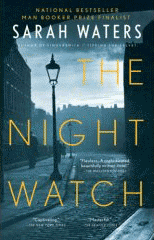
The Night Watch


I forgot to mention a few weeks ago that I finished reading The Night Watch by Sarah Waters. Despite the very different era and story format, it still has the feel of a Waters novel but I found it to be a bit lacking. The story starts in 1947 and works backward - it starts off with characters in a dark place and they're given to you without any backstory -- you find out about why they are doing what they are doing, how they got to be where they are, etc. by slowly being given their story as you go back through time. It's a really cool way of filling us in, revealing the mystery.... My only problem was that I was expecting the novel to twist and pull the rug out from under me like in the previous two Waters novels. Instead, I found the story kind of predictable and the ending disatisfying. I wanted to know much more about the characters than what we were given.

Good points were that the characters were really interesting and the backward format was well done. I liked the story itself and the telling of it. I just wish the story were longer and fuller. The lack of length and depth left me wanting more in a very wistful way -- because the story starts in despair and goes backward to a more hopeful time, you do end up feeling a bit more hopeful but again in a wistful way. Maybe that was her point. That after all is said and done, we look back to better times.

Monday, March 28, 2005

Jarhead [novel]


I finished Jarhead: A Marine's Chronicle of the Gulf War and Other Battles by Anthony Swafford. It's very from-the-gut, dark, and doesn't pull any punches. It tells of the author's unwavering drive to become a Marine and of the reality of the hell of actually BEING one and living through a war that wasn't a war out in the desert.

The book doesn't offer up any excuses, it doesn't really give you any trivial information, and it doesn't really give up any deep insights. It simply tells of what it was like, what the other Marines were like, some things he thought of during the things he went through and tells factually the things he saw and did, letting the reader take everything for what it is. War. Meaningless war. Neither pro nor anti anything. Gives you a lot to think about.

I liked the matter-of-factness of the book - makes it a balanced read for people both pro and anti war. War is what it is and this was one man's experience of it. Kind of makes my stomach lurch whenever I read a "Semper Fi" bumper sticker, though. Urgh.

Friday, March 18, 2005

The Radioactive Boy Scout


The Radioactive Boy Scout - The True Story of a Boy and His Backyard Nuclear Reactor by Ken Silverstein

I just read this book yesterday, got it out of the library and finished it the same day, which is something for me, as I usually take my time with books. But I HAD to know what happened to David Hahn, the teen who attempted to build a model nuclear breeder reactor in a potting shed in his backyard in Detroit in the 90's.

I've always had a strange fascination with radioactivity, both the facts and the fantasy of it. I don't know why; in reality it scares the bejeebers out of me yet I find information and stories about it really interesting. The history of Chernobyl, the Bikini Atol, the tests in Nevada. Post-apocalyptic fiction, particulary post nuclear-apocalyptic stories, I can't get enough of - like Z for Zachariah. The "Fallout" RPG games - getting to BE a character in this neo-retro post apocalyptic nuclear world. Films, no matter how cheesy - "The Postman", "Mad Max", the one realistic film that was made to scare people about nuclear destruction that follows some individuals trying to survive after a nuclear attack whose name I always forget...

And what makes this book even better/scarier is that it really HAPPENED.

The book was written by an investigative reporter and doesn't just tell David Hahn's story, how he managed to build something that generated extremely large amounts of radiation levels measurable from several blocks away - it also tells us the history of radioactive materials and their scientific discoveries and uses and the history of the damaging effects various radioactive materials have caused. It tells us about how the government put a happy face on atomic energy and how it was this very out-of-date information that under-informed David enough to go through with much of his experimenting. Lastly, the book details David's family life and how he was able to get away with so much with so little supervision. It's absolutely stunning and really amazing. This teenager was a chemistry genius who was figured out how to procure all kinds of highly restricted radioactive material -- and it's not an evil genius story, just a kid obsessed with a project whose consequences he never really thought about or informed himself about.

Anyway. Good read - I'm not a chemistry buff and the technical stuff was written so I could understand it but without talking down to its audience. And you really feel for David - if only his parents were more supportive, etc.

Friday, January 28, 2005

Affinity [novel]


In short, if you haven't read it, you should. Get it from the library, borrow it - something. You will be amazed, whether you like it or not (this falling into the 'mindfuck' category).

From Wikipedia: Margaret Prior (also called "Peggy" and "Aurora"), an unmarried woman from an upper class family, visits the Millbank Prison in the 1870s Victorian era England. The protagonist is an overall unhappy person, recovering from her father's death and her subsequent failed suicide attempt, and struggling with her lack of power living at home with her overinvolved mother despite being almost 30. She becomes a "Lady Visitor" of the prison, hoping to escape her troubles and be a guiding figure in the lives of the female prisoners. As she peers through a flap in the door, entranced by the sight of a girl with a flower — she is reminded of a Carlo Crivelli painting. Of all her friendships with prisoners, she is most fascinated by this girl, who she learns to be Selina Dawes, medium of spirits.

It is a Sarah Water's book, so you know that there is a woman/woman relationship involved in the character development. This story slowly unfolds, teasing the reader along. The setting is wonderful, you feel like you're going behind the scenes of a Jane Austen story to see what life was REALLY like beneath the frills and pomp - gritty and real.

DO NOT READ THE REST OF THIS POST unless you have read the book. I'm serious - you'd be so spoiled, it wouldn't be worth reading. It'd be like knowing the entire mystery and how it works BEFORE you read the mystery. In other words, there'd be no suspense, no wonderment - it'd be ruined. This means YOU.

~==~
Ok. I hope if you are reading this, you have read the book.

Hope, you were, by the way, correct in that I want to stab the author. And hug her at the same time, though, for writing so craftily what she wrote.

I feel so... gullible and tricked. It's so amazing - right at the beginning of the book, we see signs of why Selina Dawes isn't to be trusted. I was hesitant to believe her, but as surely and slowly as Miss Prior fell for her, so did I. It was SO slow and so elegant, the way the reader is drawn in - it takes over half the book before anything huge happens. Very realistic to the end in how we think everything is as it appears to be, right up to the moment the mirror is shattered, the curtains taken away and we see the world for how it really is. And in that split moment, everything seems foriegn - everything we were doing just a moment before seems like it's from another life completely - a life lived in a dream world that never counted for anything. We're left so stunned we don't know what to even THINK. We want to believe in the illusion so badly because what we felt for it was so genuine... What Margaret felt for Selina was so beautiful and true, how could it of been for nothing?

Now I feel like I'm pointing out the obvious - how unbelieveably crafty Selina was. What an actress... It was even hinted at in the beginning, but I chose to believe... like Margaret, with each movement of the spirits, I chose to believe rather than try hunting down an obvious answer. It was too easy.

Even right up to the night Margaret stayed up til dawn waiting for Selina to appear - I was right there with her. I had my inner doubts - maybe she won't come. Maybe Selina was indeed delusional from her stay in the prison. Maybe the spirits simply won't be able to do it and the two will kill themselves rather than be apart. Maybe maybe maybe... But never that maybe Selina would have other plans alltogether. Even once Mrs Jelf arrived at the house and began telling of her part in Selina's escape, I thought maybe the concentration on the spirit was just a way of distracting Margaret from negative thoughts til Selina could arrive and explain everything. Then I thought, as Mrs Jelf was revealing what SHE felt of Selina - that maybe Selina really was in love with JELF and that Selina was going to arrive and there'd be a confrontation and the two would go off together.... But in the end, I really thought that Selina was going to appear and go off with Margaret. So I was just as shocked AS Margaret with each revelation of every piece to the puzzle.

And the whole time it was RUTH VIGERS?!? I couldn't even make a sound, couldn't shake my heads. I wasn't anything yet I was everything all at once, I was so stunned. Because I should of known. Somehow, I should of seen it all along.

And I feel SO gullible. Gullible. I mean, I like to be suprised in stories - books and movies and TV shows. I try NOT to guess at what is going on. Of course, often, TV and movies are easier to guess at than books. And I think, maybe I COULD of remained objective... maybe I wouldn't of fallen for it. But Selina was too good; I was drawn in and I fell for it, too.

Now I don't know what to do with the book itself. Laugh at it, glare at it? Put it on my bookshelf with my collection? I do re-read books, but this... this isn't a story to be re-read, a world to be re-visited. This book WAS an experience. And like most life experiences, things one cannot repeat. Something one cannot go back in time and recapture. It's one of those "first time" things - the first time is always the best, full of wonder and suprise. And once that's over with, even the anticipation of the end result in subsequent experiences cannot capture that naive suprise.

Anyway. Like I said, I'm a book collector - I love my books. But I honestly dont think I'd ever be able to re-read this one. Who to pass it to, then?

I'm serious... I was just BUZZING during the chapters leading up to Selina's escape.... When she got put in the darks... I was just fluttering inside. I HAD to see what happened. I couldn't stop reading. And it built and built and built -- then... It was like jumping into a glacial lake. Solid cold came over me, slowly dripping, coating me, like a giant egg cracked over my head. And all time stopped as I found out the truth to Selina's plans.

In the end, as much as I want to throttle Sarah Waters, I want to praise her as well for such a good job. To write something like that, that can DO this to a reader - that's just amazing. *shakes Sarah's hand and thanks her for holding my heart to the light, warming it, then quickly lacerating it and stomping upon it before handing it back*. I almost feel BAD for appreciating the book - like a dominatrix who suddenly realized she liked being a bottom, liked being abused all a long.

Ok, weird analogy, but it's what came to mind. :P

Sunday, January 16, 2005

The Well of Lonliness [novel]

I guess a lot of folks disregard The Well of Lonliness because it's the "stereotypical lesbian life ending in tradgedy". But I think they forget that this book was written in the 1920's and was the first of its kind. It hits home in so many ways - I kept writing down page numbers to take notes from but the entire book is just so smart. Once you get past the [older] style of writing and remember the era it reflects, and really look into the metaphors and descriptions, boiling it down this novel is saying the same thing the queer community is saying today.

I want everyone to read it to know how I felt growing up as a kid - not just what I was like, but what I thought, how I felt -- THIS is what this book gets to the heart of. Not WHY we're gay, not why it's such a difficult topic for much of society. It goes beyond the superficial and the arguments and really digs down to personal things I've never been able to put into words. And to SEE everything actually written down, and written WELL. It's stunning. If anything, I think this book is just as valuable today if not more, as I've yet to read another novel that better cuts down to how a lot of us feel deep inside.

I warn you that it isn't a happy novel. I really felt lonely and depressed after reading it (doesn't help that I am single) so be prepared.

Sunday, April 4, 2004

Dude, Where's My Country?


I'm glad I went to the library yesterday. I had Michael Moore's "Dude, Where's My Country" in at the library and I was fresh out of new reading material. I started reading it today and I'm halfway through already and feel furious and helpless about my country and the way it's being run. How can we possibly avoid having ultra-rich morons who have their fingers in corporations around the world as our leaders when they're the only ones RICH enough to run for president? There's NEED for a law to make it so you can't use over a certain amount to campaign... It's a monopoly on who's running - if you're poor and local, no one will ever hear about you. It's sad.

All I can say about this book is that if you are unsatisfied with the obvious lies George W. has been feeding our country, just pick up this book somewhere and READ it. Easy read, funny read, educated read with lots of articles backing it up that you can apparently find on his site: www.michaelmoore.com -- actually, if you can't afford the book or can't find it at your local library, just go to his site and read some of the things there.

He's a compelling guy. It frustrates me that he's one of the few out and loud sources of the other side of the Bush/invasion(war if you wanna call it that) stories that the media feeds us. And didn't I just post a HUGE two-parter post about how much I hate lying and liars? I'm beginning to think I can't even watch TV without being pumped full of lies by the networks. ~*sigh*~ From now on, I'm sitting on the couch with a big bag of large-grained salt.

Monday, March 8, 2004

Some random books

"A Walk in the Woods" by Bill Bryson. I love his books - his humor going from cynical to happy-go-lucky in the same paragraph. He's just great. This book covers his ill-fated attempt to hike the entire Appalacian Trail. Both humerous and inspiring, it makes you want to either set out to hike the AT yourself or run screaming in the opposite direction. The book is also full of little facts and wonderful descriptions of the trail and its history along the way.

"The Mother Tongue" and "Made in America" by Bill Bryson. Both of these books have been used as textbooks in English classes all over. The first chronicles the history of English overall, its pitfalls and brilliance, comparing it to other languages as well as to its own forms across the world (i.e. British, American, Australian...) It gets down into the nitty gritty technical parts but is never boring and even though they're both extremely informative works of non-fiction, there is that signature Bryson humour threaded throughout. "Made In America" is about English in America alone, covering place names to dialects and how American English developed as a seperate entity from British English. If you love language, these are brilliant books you'll love.

"Fast Food Nation" by Eric Schlosser. Non-fiction. A look at how the fast food industry has changed the way we eat and the way food is produced and handled, not only in America but abroad as well. Kinda makes you think twice before buying burger at Safeway. Contrary to what the title suggests, this book is NOT anti-fast food, either. The author just SHOWS us how our world has changed since the advent of fast food, for better and for worse.

"A People's History of the United States" by Howard Zinn. Non-fiction. This was the text for my American History class in college. It's a heavy read, but it's the true history of the U.S. with all the dark parts added BACK in. And it doesn't forget to add any group, either - from natives and blacks to women and children. It's all here.

Scifi/Fantasty novels

A random list of scifi/fantasty books I've enjoyed in the past.

"Kushiel's Dart" by Jaqueline Carey - The best written book I've ever read. It pseudo-paralells Europe's cultures and religions in its setting, told in first person perspective wonderfully, and has more plot-on-plot than I've ever seen in my life without being confusing or dragging. It has climax upon climax, each one better than before - and you keep thinking, "geez, they've come this far and I'm only halfway through the book -what the hell could happen next?" and sure enough, it gets better. The first two chapters are a bitch to get through, but there are 98-odd chapters total, so it's really a fraction of the book and SO worth the effort. ;) First book in a trilogy, stands well on its own.

"Through Wolf's Eyes" by Jane M. Lindskold - A fun fantasy book. The main character, Firekeeper, was raised by intelligent wolves and is brought back to 'civilization'. She's a kick-ass character; no romance to muddle up the plot, and a lot of wry humour and plenty of adventure. First of three books, awesome on it's own.

"Rhapsody" by Elizabeth Haydon - Fantasy. There are four books and I've only read the first two because I started to lose interest. There is a lot of long build-up in this book, but the concepts of the world are fabulous and I find myself thinking about them years after I read it the first time.

"Wolfwalker", "Shadow Leader", and "Storm Runner" by Tara K. Harper. These were originally a trilogy and since then, the author has added to them, but I think these are by far the best. I've never read a more rip-snorting, edge-of-your-seat set of books. The very first chapter of the first book makes you squirm in agony for the character.. Dion is a strong female character, but not in a loud way. She's not invincible and she's got a lot of depth. She's not girly at ALL, either, and after 8 years she remains one of my top favourite characters. She's got a telepathic link to wolves, so if you like the lupin kind, you'll especially like these books.

"Cat Scratch Fever" by Tara K. Harper - this is sci-fi; The main character is kidnapped and taken AWAY from technology and tortured. There's a lot more to it than that, but the detail and description in this book are .. wow. It's about PAIN.

"Z for Zachariah" by Robert C. O'Brien - sci-fi kind of. Post-apocalyptic, but in a more realistic fashion. A very short book, kind of first-person as the character writes in her journal about her life alone in her valley which seems to be the only place left untouched after a nuclear strike. It's full of common-sense survival as she has to conserve resources and plan for the future by raising chickens and taking care of the few animals available to her, planting, and raiding the local store and neighbor's house for goods.

The Renshai books - two trilogies worth, one starting with "The Last of the Renshai" and the second starting with "Beyond Ragnarok" by Mickey Zucker Reichert. Fantasy. It's as if the author continues the Norse myths beginning with the Ragnarok. The first trilogy happens right before, and the second happens 400 years after. I read the second trilogy first, so when I read the first, it was like I was reading a history. The Renshai are some of the best fighters you'll ever come across... It's a solid set of books with a nice selection of characters.


"The Dark Elf Trilogy" by R.A. Salvatore. Fantasy, from the Forgotten Realms. There are what, 16 or so Drizzt Do'Urden books, but don't let that scare you. The Dark Elf Trilogy was written second but happens first - which is good. The trilogy that was written first pales in comparison and is darn right a pain in the ass to get through, but integral to the characters overall. But this trilogy stands as just... they're phenominal. Over the entire set of books all of the characters just become deeper and deeper - especially the ones that start out rather shallow. Salvatore never disappoints. His fight scenes are some of the most fluid I have ever read; he keeps it simple and is able to describe with one sentence what too many authors take paragraphs to do.

"The Deed of Paksenarrion" by Elizabeth Moon. Fantasy. Here is a tale of triumph, trial, pain, and sacrifice. The conditions of a medieval military are depicted VERY realistically except for the fact that women are about as equal as men here. Again, no romance to muddle up this character's journey - and it's one of the most epic stories I've read. Just read the damn thing. You'll see.

"The Slave and the Free" by Suzy McKee Charnas. Post-apocalyptic, kind of. It's hard to describe this book, which is actually the first two books of her "Holdfast Chronicles" in one. I reccomend reading this as opposed to just the first book for a good reason. In this version of future history, stuff got so screwed up (and it is explained how) that women and men are like two species in the way they see eachother. Men rule and women are slaves. Christianity has twisted to become a seperation of the father from the son to a religion that kills. Women have been slaves so long they cant even comprehend thinking for themselves. The first book is mostly from the perspective of two male characters - the second book takes off from the female perspective. The books aren't the best written I've ever read, but the concept is mindblowing. There are 4 books total; the first shows you things from the male perspective and you begin to loathe them. The second takes you outside their world and you see how the women think. The third you think of as a triumph for women over the men but before you even get to the fourth you realize that both sides are MORONS and that this whole series is really about how humanity can fall so far and so hard.